
Published March 2026 | Valen Research | For Educational and Informational Purposes Only
What Is TB-500?
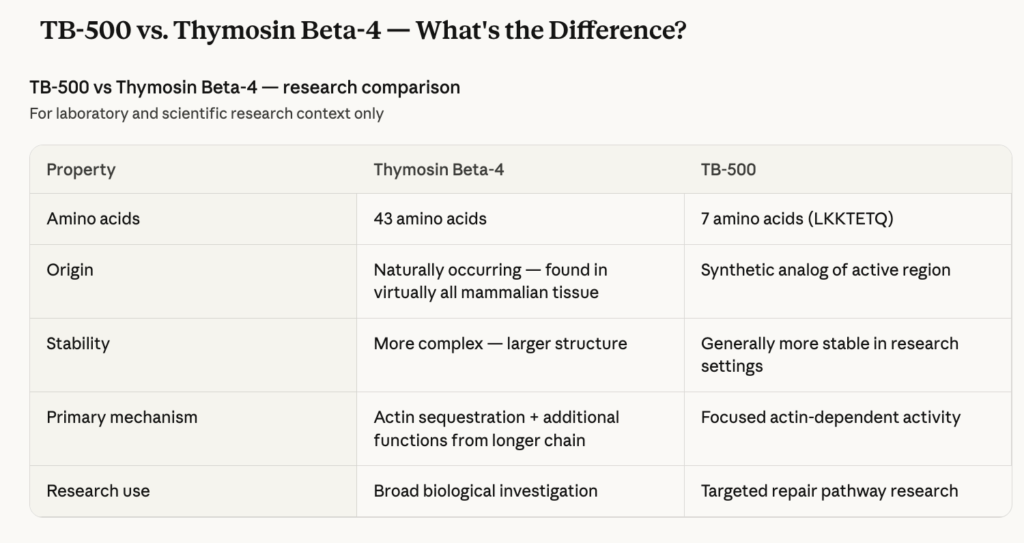
TB-500 is a synthetic analog of Thymosin Beta-4 (Tβ4), a naturally occurring peptide originally isolated from thymic tissue. Research has since confirmed its presence throughout virtually all mammalian cells, where it functions as a primary actin-sequestering protein. Spartan Peptides
Thymosin Beta-4 itself is a 43 amino acid peptide. Through systematic research, scientists identified that the first seven amino acids — the sequence LKKTETQ — retained significant biological activity comparable to the parent molecule. A landmark 2003 study demonstrated that this truncated sequence, now known as TB-500, could promote wound healing at rates similar to the full Thymosin Beta-4 molecule. parahealth
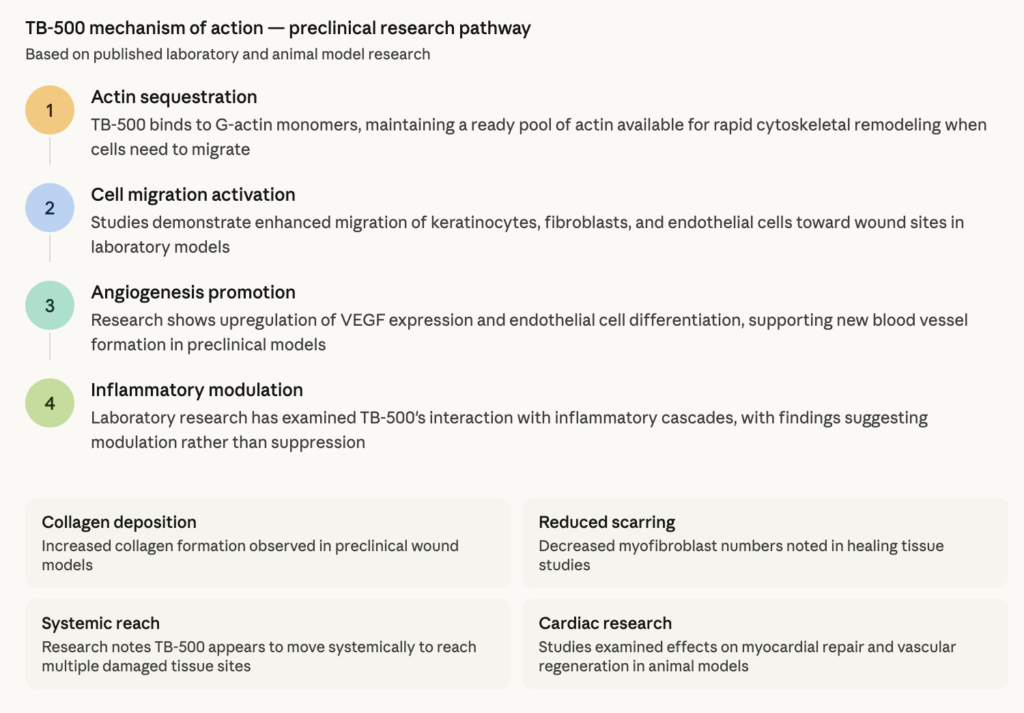
How TB-500 Works — The Actin Connection
Wound Healing Research
One of the most cited early studies on Thymosin Beta-4 examined its effects on wound healing in a rat full thickness wound model. Addition of Thymosin Beta-4 topically or intraperitoneally increased reepithelialization by 42% over saline controls at 4 days and by as much as 61% at 7 days post-wounding. Treated wounds also contracted at least 11% more than controls by day 7, with increased collagen deposition and angiogenesis observed. PubMed
Musculoskeletal Research
TB-500, as a synthetic fragment of Thymosin Beta-4, is a 43-amino acid fragment of a naturally occurring protein that promotes cell proliferation, migration, and angiogenesis. Accelerated healing of connective tissue, cardiac, and dermal wounds, as well as improved muscle recovery after endurance exercise, have been reported in preclinical models. Preprints.org
Cardiac Research
Cardiovascular research represents one of the most active frontiers in TB-500 investigation. Research published in the Annals of the New York Academy of Sciences examined thymosin beta-4's role in cardiac repair, with scientists discovering that the peptide could inhibit myocardial cell death, stimulate vessel growth, and activate endogenous cardiac progenitors. Oath Peptides
An Important Research Caveat
An important concern noted in recent research literature is that thymosin beta-4 is known to be upregulated in some metastatic cancers, facilitating the migration of tumor cells to distant sites. Consequently, TB-500 use carries a significant theoretical risk that remains an area of ongoing scientific investigation. Preprints.org This is an important consideration for any researcher designing studies involving this compound.
Regulatory Status — 2026
TB-500 was placed on the FDA's Category 2 restricted list in 2023, limiting access through licensed compounding pharmacies. It is among the peptides expected to return to Category 1 status following HHS Secretary RFK Jr.'s February 2026 announcement, pending formal FDA publication. Joinbelle
Research Context Disclaimer
All information in this post is drawn from published peer-reviewed scientific literature and is provided for educational purposes only. TB-500 available through Valen Research is classified strictly as Research Use Only (RUO). It is not intended for human or animal consumption, is not FDA-approved, and is not intended to diagnose, treat, cure, or prevent any disease or medical condition. Researchers should consult applicable institutional and regulatory requirements before working with any research compounds.
References
Malinda KM et al. FASEB Journal, 1999. PMID: 10469335
Rahman et al. J Am Acad Orthop Surg, 2026. DOI: 10.5435/JAAOSGlobal-D-25-00236
Mayfield CK et al. American Journal of Sports Medicine, 2026. PMID: 41476424
Preprints.org Safety Review, December 2025. DOI forthcoming
For research use only. Not for human or animal consumption.